

Tanzania · Migration
8 Days Serengeti Migration Photography Safari
Overview
This 8-day Serengeti migration photography safari is purpose-built for serious photographers and discerning wildlife travelers. The itinerary uses single-row photography vehicles (one guest per row, full window access on both sides), beanbag camera mounts, dawn departures and late returns, packed bush breakfasts and lunches to extend game-drive time, and a professional photography guide alongside the standard driver-guide.
Three full nights in Mara River country during peak crossing season, plus three nights in the central Serengeti for the resident big-cat populations. Premium tented camps throughout — Sayari, Serengeti Under Canvas, Sanctuary Kichakani or similar.
Highlights
- ✦Single-row photography vehicles with beanbag mounts
- ✦Dawn departures, late returns, packed bush meals
- ✦Three nights in Mara River country at peak crossing season
- ✦Premium tented camps throughout
- ✦Professional photography guide alongside driver-guide
- ✦Full day inside the Ngorongoro Crater
Day-by-day itinerary
- 1
Arusha arrival & briefing
Arusha
Welcome to Tanzania. Your driver-guide meets you at Kilimanjaro International Airport (JRO) with an Adventure Family Holiday Safaris name board and transfers you in a private vehicle to your Arusha hotel — about 50 minutes through coffee plantations and the foothills of Mount Meru. After check-in, the rest of the day is at leisure to recover from your flight, swim, or take an optional walking tour of Arusha town. Your guide returns in the early evening for a 30-minute briefing on the days ahead — route, lodges, packing, money, voltage, what to expect each morning. Welcome dinner at your hotel and overnight in Arusha.
Meals: D · Stay: Arusha Coffee Lodge
- 2
Arusha → Central Serengeti by bush flight
Arusha → Serengeti
Morning transfer to Arusha airport for the scheduled bush flight direct to the central Serengeti (about 90 minutes). Your photography guide and driver-guide meet you at the Seronera airstrip and brief you on the dedicated photography vehicle — single-row seating, beanbag mounts on each window, charging ports for camera batteries. Afternoon photography game drive in the Seronera Valley, focused on resident lion prides and leopards in the riverine forest. Sundowners on a kopje, then dinner at your premium tented camp.
Meals: B, L, D · Stay: Sanctuary Kichakani or Serengeti Under Canvas
- 3
Central Serengeti — full photography day
Central Serengeti
A full day in the Serengeti with morning and afternoon game drives. Pre-dawn coffee, then out by 6am for the diamond hours when the big cats are still hunting — leopards descend from sausage trees, cheetah scan the plains for Thomson's gazelle, and lion prides finish overnight kills. The Seronera Valley is the Serengeti's permanent water source and supports year-round wildlife concentrations. Return to camp around 11am for a late breakfast, swim and rest. The afternoon drive heads further afield — perhaps north to the Grumeti woodlands, south toward the Maswa side, or east toward the Banagi Hills — depending on where the migration is and what your guide is tracking. Sundowners on the bonnet of the Land Cruiser as the African sun melts into the horizon.
Meals: B, L, D · Stay: Same as Day 2
- 4
Central → Northern Serengeti
Serengeti
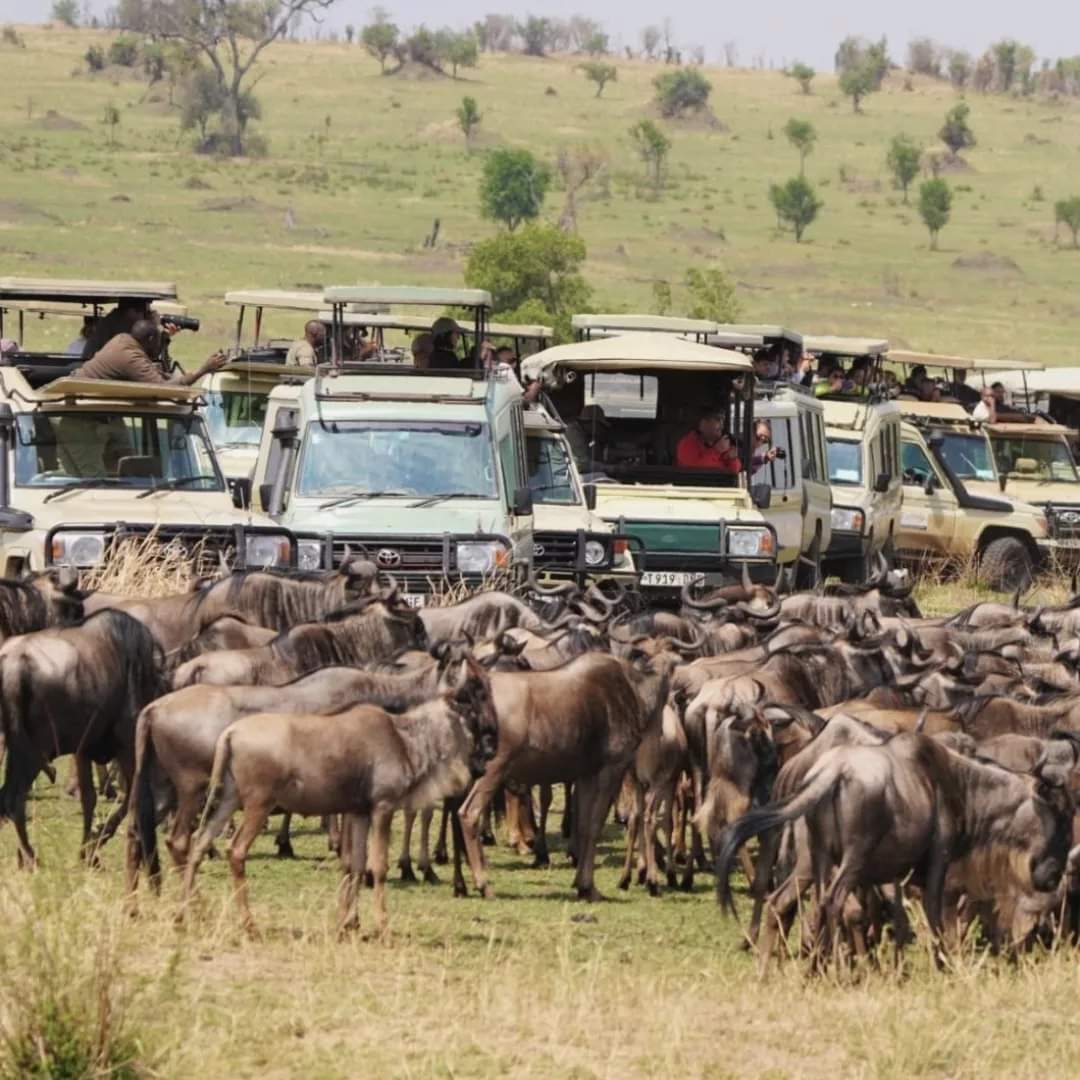
A full day in the northern Serengeti — Mara River country. From July to October, this is the stage for the most dramatic act in the great migration: the Mara River crossings. Over 1.5 million wildebeest, 200,000 zebra and 350,000 gazelle gather on the Tanzanian side and, sensing some collective imperative, throw themselves into the crocodile-filled river to reach the new grass on the far bank. Crossings can last 30 seconds or three hours; some end in slaughter, some pass without incident. Your guide tracks radio reports of build-ups all day, racing between herds when a crossing looks imminent. Outside the crossing months, the northern Serengeti is the quietest, wildest part of the park, with high resident-cat densities and far fewer vehicles. Picnic lunch on the riverbank. Dinner and overnight at your Northern Serengeti camp.
Meals: B, L, D · Stay: Sayari Camp or Lemala Mara Camp
- 5
Northern Serengeti — Mara River crossing day
Northern Serengeti
A full day in the northern Serengeti — Mara River country. From July to October, this is the stage for the most dramatic act in the great migration: the Mara River crossings. Over 1.5 million wildebeest, 200,000 zebra and 350,000 gazelle gather on the Tanzanian side and, sensing some collective imperative, throw themselves into the crocodile-filled river to reach the new grass on the far bank. Crossings can last 30 seconds or three hours; some end in slaughter, some pass without incident. Your guide tracks radio reports of build-ups all day, racing between herds when a crossing looks imminent. Outside the crossing months, the northern Serengeti is the quietest, wildest part of the park, with high resident-cat densities and far fewer vehicles. Picnic lunch on the riverbank. Dinner and overnight at your Northern Serengeti camp.
Meals: B, L, D · Stay: Same as Day 4
- 6
Northern Serengeti — second crossing day
Northern Serengeti
A full day in the northern Serengeti — Mara River country. From July to October, this is the stage for the most dramatic act in the great migration: the Mara River crossings. Over 1.5 million wildebeest, 200,000 zebra and 350,000 gazelle gather on the Tanzanian side and, sensing some collective imperative, throw themselves into the crocodile-filled river to reach the new grass on the far bank. Crossings can last 30 seconds or three hours; some end in slaughter, some pass without incident. Your guide tracks radio reports of build-ups all day, racing between herds when a crossing looks imminent. Outside the crossing months, the northern Serengeti is the quietest, wildest part of the park, with high resident-cat densities and far fewer vehicles. Picnic lunch on the riverbank. Dinner and overnight at your Northern Serengeti camp.
Meals: B, L, D · Stay: Same as Day 4
- 7
Northern Serengeti → Ngorongoro
Serengeti → Ngorongoro
After breakfast and a morning Serengeti game drive en route, climb back up the escarpment to the Ngorongoro Conservation Area. Lunch at your lodge perched on the crater rim, with vertiginous views into the world's largest unbroken volcanic caldera — 19 kilometers wide, 600 meters deep. Afternoon at leisure to enjoy the lodge facilities and acclimatize to the cooler high-altitude air. Optional walking tour to a Maasai village inside the conservation area — uniquely, the Maasai still live and graze cattle within Ngorongoro alongside the wildlife. Sundowners on the rim as the crater fills with mist below you. Dinner and overnight at your crater rim lodge — the night cold and crisp at 2,400 meters elevation.
Meals: B, L, D · Stay: Ngorongoro Crater Lodge or Lemala Ngorongoro
- 8
Ngorongoro Crater → Arusha
Ngorongoro → Arusha
A pre-dawn breakfast and an early descent into the Ngorongoro Crater — Africa's Eden. The crater floor supports one of the highest concentrations of large mammals on Earth: lion prides, the densest population of spotted hyena anywhere, an estimated 30 black rhino, vast herds of wildebeest and zebra, hippo pools, flamingos on Lake Magadi, eland, gazelle, and Cape buffalo. The crater is a self-contained ecosystem and the wildlife rarely leaves. Spend the entire day on game drive, with a picnic lunch at the Ngoitokitok Springs hippo pool. Late afternoon, climb back up the crater wall to your lodge for dinner. For most travelers, the crater day is the single most memorable of any Tanzania safari. An optional morning game drive on the crater rim or Lake Manyara if time permits, then descend to Karatu for a coffee-plantation visit en route. Continue across the Manyara escarpment and back to Arusha, arriving mid-afternoon. Drop-off at your Arusha hotel, Kilimanjaro International for international flights, or transfer onward to a Zanzibar flight. Hot lunch en route. End of safari — and we hope the start of a long love affair with Tanzania.
Meals: B, L · Stay: N/A (departure)
Included
- ✓ Airport pickup and drop-off in Arusha or Kilimanjaro International (JRO)
- ✓ Full-board lodge accommodation (sharing twin/double room)
- ✓ Private 4x4 safari Land Cruiser with pop-top roof
- ✓ English-speaking professional Tanzania-certified driver-guide
- ✓ All park entry and conservation fees as per itinerary
- ✓ Bottled drinking water during game drives
- ✓ Game drives as per itinerary
- ✓ All government taxes and TATO levies
- ✓ Flying Doctors emergency evacuation cover
- ✓ Single-row photography vehicle with beanbag mounts
- ✓ Professional photography guide alongside driver-guide
- ✓ Dawn departure & late-return permits
- ✓ Internal bush flight Arusha → Central Serengeti
Not included
- ✕ International airfare to/from Kilimanjaro International (JRO)
- ✕ Tanzania entry visa (USD $50 single-entry, available on arrival or eVisa)
- ✕ Travel insurance (mandatory)
- ✕ Beverages, soft drinks, alcoholic drinks
- ✕ Tips and gratuities to driver-guide and lodge staff
- ✕ Personal expenses, laundry, telephone, souvenirs
- ✕ Optional balloon safari, walking safari, cultural tours
What to bring
- • Lightweight neutral-color clothing (khaki, olive, beige)
- • Warm fleece for cool early morning game drives
- • Sun hat and sunglasses with UV protection
- • High-SPF sunscreen and lip balm
- • Insect repellent (DEET)
- • Comfortable walking shoes and sandals
- • Swimsuit for lodge pools
- • Binoculars (8x42 ideal for safari)
- • Camera with telephoto lens (200mm+)
- • Spare batteries, memory cards, power bank
- • Refillable water bottle
- • Anti-malarial prophylaxis (consult your doctor)
- • Yellow-fever certificate (required if arriving from yellow-fever zones)
- • Telephoto lens (400mm+ recommended)
- • Extra memory cards (256GB+ minimum)
- • Spare camera body if available
- • Lens cleaning kit and dust blower
- • Laptop or portable SSD for backup
Frequently asked questions
You may also like
Related tanzania migration safaris
 6 days · Tanzania
From $3,490 pp
6 Days Serengeti Great Migration Safari — River Crossings
Time your Tanzania safari to the world's greatest mammal migration — 1.5 million wildebeest crossing crocodile-filled rivers in the northern Serengeti, July through October.
View itinerary → 5 days · Tanzania
From $2,890 pp
5 Days Ndutu Calving Season Migration Safari (December–March)
Southern Serengeti / Ndutu when 8,000 wildebeest calves are born per day and predator action is at its peak — the migration's other great chapter.
View itinerary → 10 days · Tanzania
From $2,922 pp
10 Days Tanzania Migration Circuit — Serengeti, Mara River Crossings & Ngorongoro
Time it to the Mara River crossings — the world's greatest mammal migration, photographed from the front row. Ten days designed around the wildebeest's most dramatic chapter.
View itinerary →